


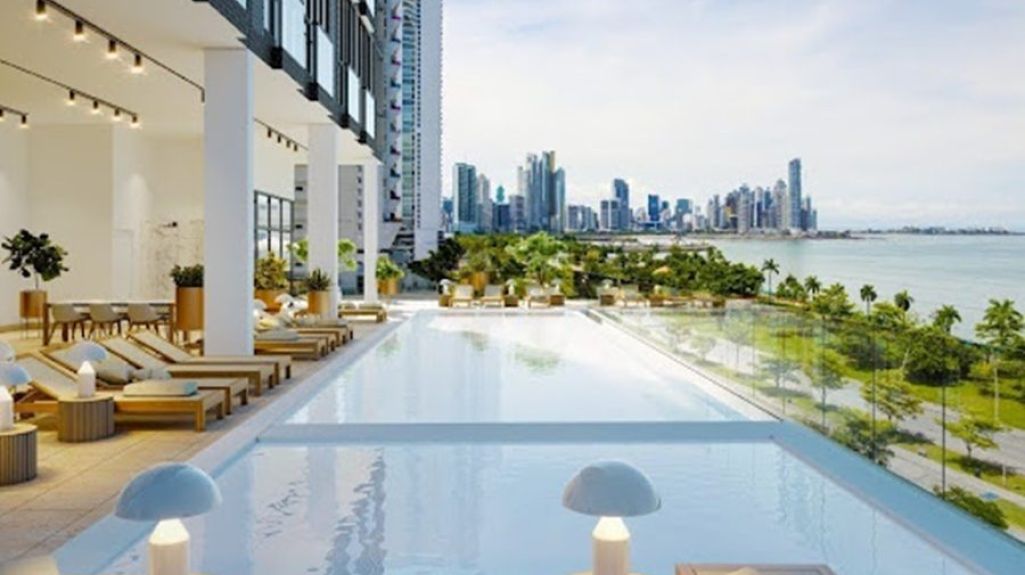
Investing in Oceanfront Apartments in Panama: A Guide for Professional Buyers (2026)
For an investor seeking oceanfront properties in Panama, these must be analyzed less as an aspirational asset and more as a scarce real estate asset within an urban market backed by solid macroeconomic fundamentals.
That is to say, their value depends not only on the ocean view, but on a combination of factors: economic growth, international connectivity, tourism demand, mortgage market depth, construction activity, and limited supply in consolidated coastal areas.
As a country experiencing steady growth, Panama should not be evaluated as a short-term speculative bet, but rather as a service-driven market with structural demand, connectivity, and urban assets with limited availability.
For instance, the World Bank estimates that Panama recovered to a growth rate of 4.4% in 2025 and projects an annual expansion near 4% between 2026 and 2028, driven primarily by services, finance, logistics, and Canal-related activities.
Based on these and many other indicators, we at RI Group have analyzed the demand for oceanfront apartments in Panama and created this guide specifically designed for those interested in a secure, data-backed real estate investment.
| Indicator | Recent Data | Takeaway for Investors |
| 2025 GDP Growth | 4.4% (World Bank) | Recovery following the 2024 slowdown |
| 2026–2028 GDP Projection | ~4.0% annually | Stable macroeconomic environment for real estate investment |
| 2025 International Visitors | 3,004,266 | Relevant external demand for rentals and second homes |
| 2025 Tourism Revenue | B/.6,583 million | Increased economic impact and associated consumption |
| 2025 Tocumen Passengers | 20,978,865 | High international connectivity |
| Jan–Mar 2026 Construction Value | +36.3% YoY | Re-acceleration of private permits |
| March 2026 Residential Value | +82.1% YoY | Specific signal of residential segment recovery |
| April 2025 Residential Mortgage Portfolio | USD 18,749.9 million | Financial market with strong mortgage depth |
In real estate, physical scarcity is one of the most important factors for capital protection. In Panama City, areas with direct or near-direct ocean exposure—such as Avenida Balboa, Punta Pacífica, and certain sectors of Costa del Este—cannot expand indefinitely.
This sets oceanfront apartments in Panama apart from other residential projects. Urban land with unobstructed ocean views is finite, while demand stems from high-net-worth profiles: executives, expatriates, international buyers, institutional/wealth-preservation investors, and families seeking premium properties.
The critical metric here is not just the presence of demand, but the ecosystem supporting it. Panama welcomed 3,004,266 international visitors in 2025—an 8.2% increase compared to 2024. Additionally, foreign currency earnings from tourism reached B/.6,583 million, up 9.7% year-over-year.
Tourism, connectivity, and international mobility continuously feed demand for executive rentals, regulated short-term rentals, second homes, and long-term asset acquisition.
One of the strongest arguments for investing in premium properties in Panama is connectivity. Tocumen International Airport processed 20,978,865 passengers in 2025, an 8.6% growth over the previous year. In international traffic, Tocumen logged 20,739,033 passengers and was ranked the number-one airport in Latin America and the Caribbean in that segment, according to preliminary ACI-LAC data.
This has a direct implication for real estate: strong air connectivity reduces friction for foreign buyers, regional executives, and companies operating from Panama toward other markets.
For oceanfront properties, this factor is particularly relevant because international buyers do not evaluate the property in isolation. They evaluate access, mobility, ease of travel, medical services, banking, corporate infrastructure, and overall quality of life.
Building permits serve as one of the best leading indicators for real estate activity. They do not measure final sales, but they do indicate development intent, private investment trends, and market direction.
According to preliminary INEC figures, the total value of private constructions, additions, and repairs grew 103.6% in March 2026 compared to March 2025. During that same month, the residential class grew 82.1% and non-residential grew 161.6%.
Between January and March 2026, the total value of private constructions, additions, and repairs increased 36.3% compared to the same period in 2025. Within the Panama district, cumulative growth reached 20.3%, with cumulative residential value growing 1.0% and non-residential growing 89.0%.
The takeaway for investors is clear: the market shows signs of re-acceleration, but not uniformly. Strong growth in permit numbers does not automatically make every project attractive. It means activity is picking up, requiring investors to filter opportunities strictly by location, developer track record, expected absorption, and target demand profile.
To evaluate oceanfront apartments, it is helpful to examine the performance of multi-family buildings within the residential sector.
In the first half of 2025, INEC reported that the Province of Panama recorded B/.175.1 million in private residential construction value. Of that total, B/.140.9 million corresponded to apartment buildings. Within the District of Panama specifically, apartment buildings represented B/.132.5 million of the reported residential value.
This confirms that the vertical component continues to hold significant weight in metropolitan residential construction. For a professional buyer, this data should not be interpreted as "every apartment is a good investment," but rather as proof that capital continues to flow into vertical formats—especially in land-constrained urban zones.
A healthy real estate market requires buyers with access to financing. Panama features a deep banking system and a substantial residential mortgage portfolio.
The Superintendency of Banks reported that, as of April 2025, the residential mortgage portfolio reached USD 18,749.9 million, representing a 2.5% year-over-year increase compared to April 2024. Within that total, residential credit under the Preferential Interest Law grew 4.5%.
Although oceanfront properties typically sit above the preferential housing price bracket, these metrics confirm financial depth and sustained housing credit demand. This supports overall market liquidity, particularly in resale transactions and financing for local buyers or foreign residents.
For investment purposes, liquidity depends on three additional factors: correct entry pricing, asset differentiation, and a location with constant demand. An oceanfront apartment in a consolidated neighborhood will maintain better downside protection than a generic unit in an oversupplied zone.
Rental demand for oceanfront properties in Panama does not rely solely on tourism, though tourism provides a clear signal regarding the country's international appeal.
In 2025, Panama registered over 3 million international visitors and 2,330,677 overnight tourists—an 11% increase. For the first quarter of 2026, the Tourism Authority reported a 17.3% increase in visitor arrivals and a 15.6% increase in tourism revenue.
This data suggests a favorable backdrop for assets located in areas with tourist, corporate, and residential appeal. However, investors should distinguish between three distinct strategies:
Long-Term Residential Rental
Executive / Corporate Rental
Capital Preservation with Resale Potential
Oceanfront properties perform best when combining at least two of these strategies. For example:
Avenida Balboa attracts both executive rentals and capital preservation buyers.
Punta Pacífica appeals to families, medical professionals, executives, and high-net-worth buyers.
Costa del Este caters primarily to corporate executives and family demographics.
Avenida Balboa is one of Panama City's premier real estate corridors. Its primary strength lies in combining ocean views, proximity to the financial district, urban connectivity, and direct access to the Cinta Costera. From an investment perspective, its value stems from the scarcity of comparable locations.
Punta Pacífica positions itself in a higher-end premium segment. Its proximity to top-tier hospitals, shopping malls, financial services, and high-profile residential towers makes it a stronghold for high-net-worth buyers. Investments here rely less on a "low entry price" logic and more on value preservation, executive demand, and international prestige.
While not strictly oceanfront in every project, Costa del Este forms a key part of the city's premium coastal axis. Its master-planned urban layout, corporate presence, and modern residential inventory make it highly attractive to families and multinational executives, offering demand stability and structured urban living.
Without proper analysis, an investment carries inherent risks. In this market, primary risks include:
Overpaying for an ocean view without reviewing local comps
Purchasing in low-differentiation projects within high-competition submarkets
High monthly HOA and maintenance fees eroding net yield
Over-reliance on short-term/vacation rentals
Mismatch between purchase price and realistic rental demand
Neglecting resale liquidity analysis
Before purchasing new oceanfront apartments in Panama, review the following criteria:
Exact Location: Neighborhood names alone are insufficient. Significant differences exist by building, orientation, noise levels, access routes, actual view, and proximity to services.
Protected Views: Unobstructed ocean views justify higher pricing. However, confirm whether the view is permanently protected or subject to future adjacent developments.
Price Per Square Meter: Compare pricing against directly comparable units, rather than citywide or neighborhood averages.
Target Rental Demand: Define a clear tenant profile: executives, expatriates, families, diplomats, medical professionals, or second-home buyers.
Operating Expenses: In premium properties, HOA fees, maintenance, property management, and insurance significantly impact net returns.
Exit Liquidity: Evaluate not only potential rental yields, but also the ease of reselling the asset in 5, 7, or 10 years.
Positive Macro Outlook: Panama maintains strong economic projections, with medium-term growth projected near 4% by the World Bank and IMF.
Expanding Global Reach: International connectivity and tourism continue to grow, evidenced by over 20.9 million Tocumen passengers in 2025 and over 3 million international visitors nationwide.
Selective Supply Growth: Building permits show recovery in 2026, but with significant variation across districts and sectors. This demands disciplined asset selection over generic pre-sale purchases.
At RI Group Panama, we assist local and international investors in evaluating oceanfront properties through a financial lens.
Our team analyzes location, appreciation potential, rental demand, project profiles, and exit strategies to identify opportunities aligned with long-term wealth preservation goals.
Explore our portfolio of oceanfront apartments, resale properties, and new developments across Panama's top locations—including Avenida Balboa, Punta Pacífica, and Costa del Este. Contact us today for personalized market analysis and investment guidance.
© 2026 RI Group. All rights reserved.